Component Palette Icon

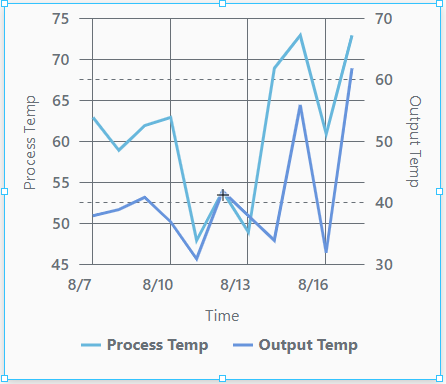
The XY Chart displays data trends. It provides a flexible way to display either timeseries or X-Y data by entering data in the dataSources property. It is fully customizable in its appearance, from labels, colors, line widths, legend, scroll bars, and text styles.
Properties
Most Properties have binding options. For more information on Bindings, see Types of Bindings in Perspective. This section only documents the Props Category of properties. The other Categories are described on the Perspective Component Properties page.
| Name | Description | Property Type |
|---|
| dataSources | The data source objects used to populate the chart. Each data source contains an array of records used by axes and series configurations. When using a date or time x-axis, the data must be sorted in ascending timestamp order. | Object |
| title | The configuration for the chart title. - text: The text displayed as the chart title.
- appearance: The configuration settings that control the visual styling of the title.
- color: The color of the title text.
- font: The font settings applied to the title text.
- size: The font size of the title text in pixels or points.
- weight: The font weight of the title text.
- padding: The spacing around the title.
- top: The padding above the title.
- bottom: The padding below the title.
- left: The padding to the left of the title.
- right: The padding to the right of the title.
| Object |
| subtitle | The configuration for the chart subtitle. - text: The text displayed as the chart subtitle.
- appearance: The configuration settings that control the visual styling of the subtitle.
- color: The color of the subtitle text.
- font: The font settings applied to the subtitle text.
- size: The font size of the subtitle text in pixels or points.
- weight: The font weight of the subtitle text.
- padding: The spacing around the subtitle.
- top: The padding above the subtitle.
- bottom: The padding below the subtitle.
- left: The padding to the left of the subtitle.
- right: The padding to the right of the subtitle.
| Object |
| legend | The configuration for the chart legend. - enabled: Enables the display of the legend.
- position: The position of the legend relative to the chart.
- absolute: The position of the legend when using absolute placement.
- x: The horizontal position of the legend.
- y: The vertical position of the legend.
- markers: The configuration settings for legend markers.
- enabled: Enables markers in the legend.
- width: The width of each marker in pixels.
- height: The height of each marker in pixels.
- mirrorLookOfSeries: Determines whether markers match the appearance of the associated series.
- stroke: The stroke settings for marker outlines.
- color: The stroke color of the marker.
- width: The stroke width in pixels.
- opacity: The stroke opacity from 0 to 1.
- cornerRadius: The corner radius applied to markers.
- topLeft: The top-left corner radius.
- topRight: The top-right corner radius.
- bottomLeft: The bottom-left corner radius.
- bottomRight: The bottom-right corner radius.
- icon: The icon configuration for legend markers.
- path: The icon path in the format library/iconName.
- color: The color of the icon.
- verticalCenter: The vertical alignment of the icon.
- horizontalCenter: The horizontal alignment of the icon.
- width: The width of the icon in pixels.
- height: The height of the icon in pixels.
- labels: The configuration settings for legend labels.
- text: The template string applied to legend labels.
- font: The font settings applied to legend labels.
- weight: The font weight of the label text.
- size: The font size of the label text.
- color: The color of the label text.
| Object |
| cursor | The configuration for the chart cursor. - enabled: Enables cursor interactions on the chart.
- series: The series that the cursor is bound to.
- lineX: The configuration settings for the X axis cursor line.
- enabled: Enables the X axis cursor line.
- stroke: The stroke settings for the X axis cursor line.
- color: The color of the cursor line.
- width: The width of the cursor line in pixels.
- opacity: The opacity of the cursor line from 0 to 1.
- dashArray: The dash pattern used to render the cursor line.
- lineY: The configuration settings for the Y axis cursor line.
- enabled: Enables the Y axis cursor line.
- stroke: The stroke settings for the Y axis cursor line.
- color: The color of the cursor line.
- width: The width of the cursor line in pixels.
- opacity: The opacity of the cursor line from 0 to 1.
- dashArray: The dash pattern used to render the cursor line.
- enableTransitions: Enables transition animations for cursor interactions.
| Object |
| enableTransitions | Enables transition animations. The default value is false. | Boolean |
| scrollBars | The configuration for the chart scrollbars. - horizontal: The configuration settings for the horizontal scrollbar.
- enabled: Enables the horizontal scrollbar.
- series: The series associated with the horizontal scrollbar.
- vertical: The configuration settings for the vertical scrollbar.
- enabled: Enables the vertical scrollbar.
- series: The series associated with the vertical scrollbar.
| Object |
| selection | New in 8.1.10 The configuration for selecting data points. Data points can be selected when series[x].render is set to column, candlestick, or line with bullets enabled. - enabled: Enables selection of bullets, columns, and candlesticks.
- data: The array of currently selected data points.
- selectedHighlightColor: The highlight color applied to selected data points.
| Object |
| background | The configuration for the chart background. - render: The background render mode.
- gradient: The configuration settings for gradient backgrounds.
- stops: The gradient stop definitions.
- color: The color of each gradient stop.
- opacity: The opacity of each gradient stop from 0 to 1.
- rotation: The rotation angle of the gradient.
- color: The background color when using a solid fill.
- opacity: The background opacity from 0 to 1.
| Object |
| xAxes | The configuration for X axes. See the X Axes Properties section below for more details. | Array |
| yAxes | The configuration for Y axes. See the Y Axes Properties section below for more details. | Array |
| series | The array of series configurations applied to the chart. See the Series Properties section below for more details. | Array |
| style | The style configuration for this component. A full menu of style options is available. You can also specify a style class. | Object |
Axes Properties
Axes define how data is mapped and displayed on the chart. Each axis configuration controls scaling, labeling, formatting, and visual presentation. Multiple axes can be defined and referenced by series to control how data is rendered.
xAxes[x] Properties
| Name | Description | Property Type |
|---|
| name | A unique name used to identify this axis configuration. This value is required for series configuration. | String |
| label | The configuration for the axis label. - enabled: Enables a label displayed alongside the axis.
- text: The text displayed for the axis label.
- color: The color of the axis label text.
| Object |
| inversed | Determines whether the axis scale is inverted, reversing the direction of values. | Boolean |
| visible | Controls the visibility of the axis. | Boolean |
| tooltip | The configuration for the axis tooltip. - enabled: Enables tooltips for the axis.
- text: The tooltip text as a format string.
- cornerRadius: The corner radius of the tooltip.
- pointerLength: The length of the tooltip pointer in pixels.
- background: The background settings for the tooltip.
- color: The background color of the tooltip.
- opacity: The background opacity from 0 to 1.
| Object |
| render | The axis type to render. Options include category, date, or value. The default value is date. | String |
| category | The configuration for category axis breaks. - enabled: Enables a category break range.
- startCategory: The starting category of the break.
- endCategory: The ending category of the break.
- size: The size of the break as a decimal percentage of removed values.
| Object |
| date | The configuration for date-based axes. - baseInterval: The base interval settings for the axis.
- enabled: Enables base interval configuration for the axis.
- timeUnit: The base time unit.
- count: The number of time units per interval.
- skipEmptyPeriods: Removes empty time units from display. This setting may affect performance and overrides axis break behavior when enabled.
- range: The range settings for the axis.
- max: The maximum date in the range as a Unix timestamp in milliseconds.
- min: The minimum date in the range as a Unix timestamp in milliseconds.
- useStrict: Strictly enforces the configured date range.
- break: The formatting settings for date values.
- inputFormat: The date format of values provided by the data source.
- format: The date format used to display axis labels.
| Object |
| value | The configuration for value-based axes. - range: The range settings for the axis.
- max: The maximum numeric value in the range.
- min: The minimum numeric value in the range.
- useStrict: Strictly enforces the configured value range.
- logarithmic: Uses logarithmic scaling for the axis, which is useful when values vary significantly.
- break: The configuration for value breaks.
- enabled: Enables a value break range.
- startValue: The starting value of the break.
- endValue: The ending value of the break.
- size: The size of the break as a decimal percentage of removed values.
- format: The number format applied to axis values.
| Object |
| appearance | The configuration for the visual appearance of the axis. - opposite: Renders the axis on the opposite side of the chart.
- inside: Renders axis labels on the inside of the axis.
- labels: The label styling configuration.
- color: The color of the axis labels.
- opacity: The opacity of the axis labels from 0 to 1.
- rotation: The rotation of the labels in degrees.
- wrap: Wraps the label text.
New in 8.1.14 verticalCenter: The vertical alignment of the label.New in 8.1.14 horizontalCenter: The horizontal alignment of the label.
- grid: The grid line styling configuration.
- color: The color of the grid lines.
- opacity: The opacity of the grid lines from 0 to 1.
- dashArray: The dash pattern used to render grid lines.
- minDistance: The minimum distance between grid lines in pixels.
- position: The relative position of grid lines from 0 to 1.
- font: The font settings applied to axis labels.
- size: The font size used for axis labels.
- weight: The font weight used for axis labels.
| Object |
yAxes[x] Properties
| Name | Description | Property Type |
|---|
| name | A unique name used to identify this axis configuration. This value is required for series configuration. | String |
| label | The configuration for the axis label. - enabled: Enables the axis label.
- text: The text displayed for the axis label.
- color: The color of the axis label text.
| Object |
| inversed | Determines whether the axis scale is inverted. | Boolean |
| visible | Controls the visibility of the axis. | Boolean |
| tooltip | The configuration for the axis tooltip. - enabled: Enables the tooltip.
- text: The tooltip text as a format string.
- cornerRadius: The corner radius of the tooltip.
- pointerLength: The length of the tooltip pointer in pixels.
- background: The background settings for the tooltip.
- color: The background color of the tooltip.
- opacity: The background opacity from 0 to 1.
| Object |
| render | The axis type to render. Options include category, date, or value. The default value is date. | String |
| category | The configuration for category axis breaks. - enabled: Enables a category break range.
- startCategory: The starting category of the break.
- endCategory: The ending category of the break.
- size: The size of the break as a decimal percentage of removed values.
| Object |
| date | The configuration for date-based axes. - baseInterval: The base interval settings for the axis.
- enabled: Enables base interval configuration.
- timeUnit: The base time unit.
- count: The number of time units per interval.
- skipEmptyPeriods: Removes empty time units from display.
- range: The range settings for the axis.
- max: The maximum date in the range as a Unix timestamp in milliseconds.
- min: The minimum date in the range as a Unix timestamp in milliseconds.
- useStrict: Strictly enforces the configured range.
- break: The formatting settings for date values.
- inputFormat: The date format of values provided by the data source.
- format: The date format used to display axis labels.
| Object |
| value | The configuration for value-based axes. - range: The range settings for the axis.
- max: The maximum numeric value in the range.
- min: The minimum numeric value in the range.
- useStrict: Strictly enforces the configured range.
- logarithmic: Uses logarithmic scaling for the axis.
- break: The configuration for value breaks.
- enabled: Enables a value break range.
- startValue: The starting value of the break.
- endValue: The ending value of the break.
- size: The size of the break as a percentage of removed values.
- format: The number format applied to axis values.
| Object |
| appearance | The configuration for the visual appearance of the axis. - opposite: Renders the axis on the opposite side of the chart.
- inside: Renders axis labels on the inside of the axis.
- labels: The label styling configuration.
- color: The color of the labels.
- opacity: The opacity of the labels.
- rotation: The rotation of the labels.
- wrap: Wraps the label text.
New in 8.1.14 verticalCenter: The vertical alignment of the label.New in 8.1.14 horizontalCenter: The horizontal alignment of the label.
- grid: The grid line styling configuration.
- color: The color of the grid lines.
- opacity: The opacity of the grid lines.
- dashArray: The dash pattern used to render the grid lines.
- minDistance: The minimum distance between grid lines.
- position: The relative position of the grid lines.
- font: The font settings applied to axis labels.
- size: The font size of the labels.
- weight: The font weight of the labels.
| Object |
series[x] Properties
Each series defines how data from a data source is rendered on the chart, including axis mapping, appearance, and interaction behavior.
Component Events
Perspective Component Events
The Perspective Event Types Reference page describes all the possible component event types for Perspective components. Not all component events support each Perspective component. The Component Events and Actions page shows how to configure events and actions on a Perspective component. Component scripting is handled separately and can be accessed from the Component menubar or by right clicking on the component.